
Mindlessness


Lately I've found myself relentlessly playing Tetris on the computer. It's a game of manipulating a falling geometric shape into a row of other shapes with the goal of making a solid line of blocks. When the line of blocks is complete, they disappear and the player earns points for every solid row.
The catch is, the player has to place the shape into its optimum spot before the shape hits the bottom of the row. It's not too complicated, probably not that exciting, but I find it relaxing.
For a recent holiday, my spouse gave me a computer game called Smart Games Challenge #1. It consists of twenty individual games for an assortment of skills and interests. The three games I like the best, and played until I had reached the top scores possible, all had the same theme:
Take an object and put it in its place using the most efficient route possible.
Some nights I'd play for hours. Before we purchased our computer, I was a fiend for the daily crossword puzzle printed in the local newspaper. I absolutely loved figuring out the right answer from the clues and writing them down in the little boxes. It was so neat and tidy; the wrong answer wouldn't fit into the puzzle. There was one way to do it correctly and I relished the challenge.
 That would be my reward every morning. I'd make beds, clean the kitchen and begin a major chore for the day. Then I would sit down and treat myself to the crossword puzzle and a cup of tea while my little one played with her farm set.
I remember years ago, my dad took me to a fast food restaurant. It was very busy, the lines were long, the customers were getting impatient. There was one worker in the drive-through, two cooks behind the grill and one person left to provide counter service for at least twenty or more customers.
Amazingly, after every order, the cashier would carefully realign the straw holder, the pencils, the napkin dispenser and the condiments tray, taking great pains to put everything in its proper order. Dad commented that the cashier must be a bit overwhelmed.
I questioned him, and he responded, "Look how she is trying to keep order around herself when everything else seems to be getting out of hand. She doesn't want to lose control, so she's controlling her environment." Ah, the light goes on in my mind.
My own life has lately felt a bit overwhelming. I recently found out that I'm expecting our fourth child. And while I had thought that this would be a wonderful addition to our family, I'm suddenly feeling inundated with the demands of parenting three young children, running a household and physically growing a new baby.
My life seems to be spilling over the edges. In order to cope with all of these duties, I've been turning, with a compulsion heretofore unexperienced, to my computer game.
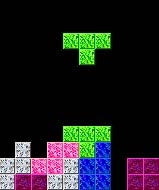 It's all so black and white, cut and dried--a perfect escape from my real life world which has too many decisions to be made and too many laundered clothes to fold. All of us need some little escape valves, a way to distract our attention from the routine, yet necessary tasks of homemaking.
The old fallacy that a woman who stays at home has more than enough time to keep house and volunteer at school and run extra errands as a favor to her "working" neighbor is just that, a fallacy. The truth is, I am doing all of those things and much more.
The incredible variety of activities which I do tends to put me out-of-focus. When I lose my focus, I start to lose control over my life. Something as simple as a computer game seems to clear my brain, emptying it of all the myriad details, and allowing me to reorder my priorities and reset my objectives.
I suppose it's a lot like meditating or prayerful quiet time. What does it for me is Tetris, fitting those odd little shapes into their respective spots and making it all vanish before my eyes.
Susan Budig has been married to Tom Reimler since 1988, and is mama to Sarah ('90), Karen ('93), & Joseph ('96).
